Product Family 04
Fibers must be selected by the crack mechanism they are expected to control
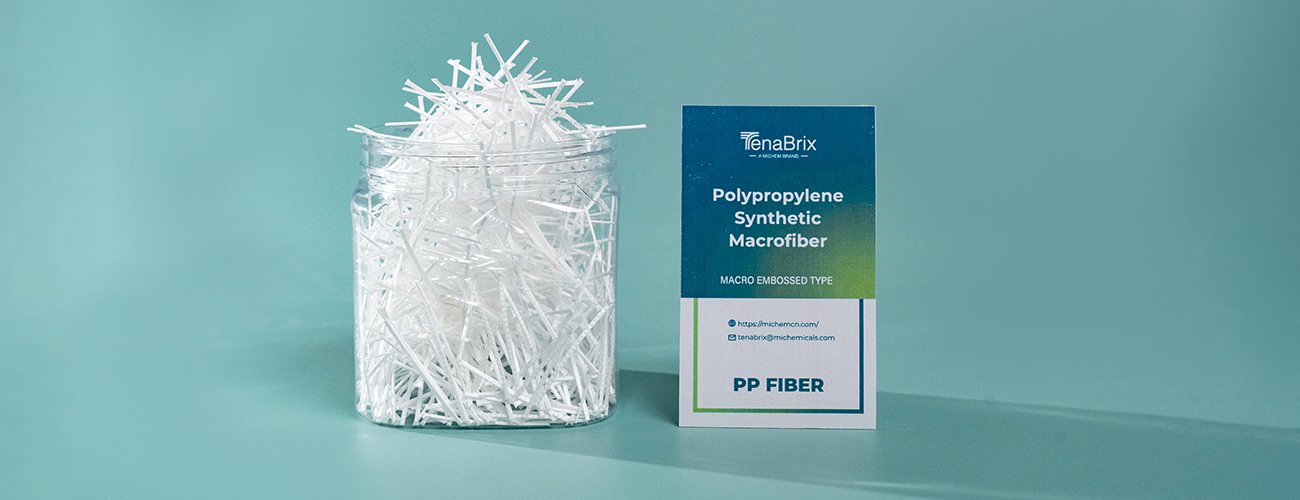
MICHEM’s fiber range covers polypropylene monofilament fibers, synthetic macrofibers, cellulose fibers, POM fibers, glass fibers and steel fibers, with additional forms such as hooked, twisted, embossed and wavy geometries.
“Fiber reinforcement” is too broad to be a useful specification. A fine polypropylene microfiber added for plastic shrinkage crack control performs a different job from a macro-synthetic or steel fiber used to increase post-crack toughness. Fiber length, diameter, aspect ratio, tensile strength, elastic modulus, surface geometry, dosage and dispersion all influence performance and processing.
The first selection question is therefore when the crack develops and what the fiber is expected to do after that crack starts. Microfibers can distribute a large number of fine filaments through the matrix and are commonly evaluated for early-age crack control. Macrofibers and steel fibers are evaluated where residual load capacity, toughness or larger-scale crack bridging matters. Glass and cellulose fibers serve different formulation roles and should not be treated as substitutes based on length alone.
More fiber is not automatically better. Higher dosage makes dispersion and finishing more demanding, and poor distribution can create local inconsistency. Any proposal to replace conventional reinforcement requires project-specific structural design and the applicable engineering standard.
Choose this family when the problem is crack formation, crack propagation, toughness or dimensional stability rather than fresh-mix rheology alone.









 01